In this article
The W formation for serve receive
Most amateur teams receive in a W: three players across the middle, two deeper on the sides, and one player near the net ready to receive the first pass and set up the attack. Before every serve, each receiver knows which balls are hers and calls “mine” early.
Five tactical rules
- First contact high and to the front: give your front row time.
- Use all three contacts when you are under pressure; attack on the second when the defense is open.
- Serve to the weakest receiver or to the seam between two players.
- After you attack, the team moves in to cover a blocked ball.
- Use time-outs to stop the opponents’ run, not only when you are losing badly.
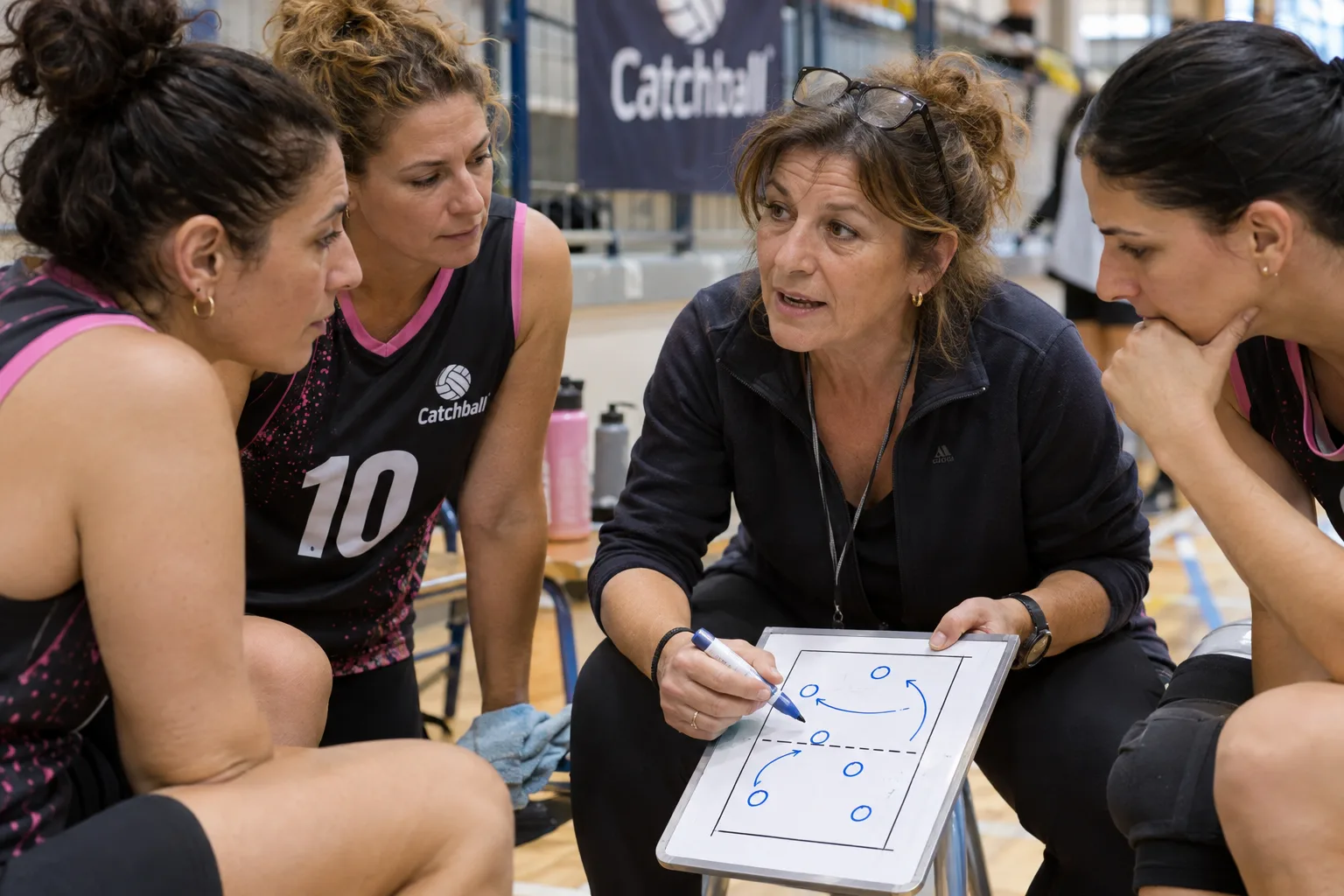
Each team has 2 time-outs of 30 seconds per set: use one when the opponents win three or four points in a row.
 RelatedThe second pass: how to set up the perfect catchball attack
Calling the ball
Most points lost on serve receive are lost between two players. Agree on simple rules before the match: the player moving forward takes the ball over the one moving back, the player in the middle takes balls in the seam, and whoever calls “mine” first owns it. Say it loudly, early and once.
From receive to attack in three contacts
- Catch the serve cleanly and pass high to the setter zone between positions 2 and 3.
- The setter turns and passes to an attacker, front or back, with a quick look at the block.
- The attacker throws to an open zone or, under pressure, plays safe deep into the court.
Defensive positioning
When the opponent attacks from position 4, your block forms in front of their attacker, the back-row player behind the block covers the short ball, and the other two back-row players stay deep in the corners. Shift as a unit; gaps open when one player watches the ball instead of moving.
Serving tactics
A serve does not need to be unreturnable to win points. It needs to create a problem: make the best attacker catch, force a receiver to move, or land in the seam where two players hesitate. Agree on a serving plan before each set and adjust after every timeout.
- Serve at the player who just made an error; confidence is fragile.
- Serve short when the receivers stand deep, deep when they creep forward.
- Serve at the setter when she is in the back row, so she has to catch first and set second.
Reading the opponents
Spend the first rallies watching. Who catches cleanly and who does not? Which attacker gets the ball when the game is tight? Does the setter always go to the same side? Two or three observations shared at a timeout are worth more than any general plan.
Timeouts and substitutions
Each team has two time-outs of 30 seconds per set under ICF rules. Use them to stop the other team’s run, not to talk about everything: one instruction for the defense and one for the attack. Substitutions are a tool too: a fresh server or a calm receiver can change a set.
A simple game plan template
| Phase | Our plan | Trigger to change |
|---|---|---|
| Serve | Target their zone 5 receiver | Two clean receptions in a row |
| Receive | W formation, setter in zone 2–3 | Two lost points on serve |
| Attack | Left front first, then cross-court | Block reads it twice |
| Defense | Block line, dig cross | Two points lost down the line |
Enjoyed it? Share it with your team