Catchball is played by two teams of 6 on an 18 × 9 m court with a net 2.24 m high. Players catch and throw the ball instead of hitting it. Each team has up to 3 contacts to return the ball, a player may hold it for 1 second at most and take 1 step before passing, and a match is best of three sets (25, 25 and 15 points under ICF rules; Mamanet plays to 21), always won by 2.
The key numbers
| Rule | ICF 2022 |
|---|---|
| Court | 18 × 9 m (two 9 × 9 m halves) |
| Attack line | 3 m from the center line |
| Net height (center) | 2.24 m |
| Ball | 65–67 cm circumference, 260–280 g |
| Players on court | 6 per team |
| Contacts per side | Up to 3 (a block does not count) |
| Holding the ball | 1 second at most |
| Steps | 1 to pass; up to 2 before a jump throw |
| Serve | Within 5 seconds of the whistle |
| Sets | Best of 3: 25, 25, 15 points, win by 2 |
| Time-outs | 2 per team per set, 30 seconds |
| Substitutions | Up to 6 per team per set |
The court
The court is 18 m long and 9 m wide, split by the center line under the net into two 9 × 9 m halves. A free zone of at least 2 m surrounds it, and the space above must be clear to at least 5 m.
On each side an attack line is drawn 3 m from the center line. It divides the front zone, where attacks above the net are allowed for front-row players, from the back zone. The serving zone is 9 m wide and lies behind each end line; the end line itself is not part of it.
Net, antennae and ball
The net is 2.24 m high at the center (the same as women’s volleyball), 1 m wide and 9.5–10 m long. Two antennae stand above the side lines; the ball must cross the net between them, in the crossing space.
The ball has a circumference of 65–67 cm and weighs 260–280 g, the size of a volleyball. All balls used in a match must meet the same standard.
Team, positions and rotation
Each team has 6 players on court, three in the front row and three in the back row. A team needs at least 6 eligible players to play. Positions are checked when the ball leaves the server’s hand.
When the receiving team wins a rally it gets the serve and rotates one position clockwise. Being out of position is a fault that gives the point and serve to the other team.
Up to 2 Liberos may be registered per set. The Libero wears a different color, may replace any back-row player without it counting as a substitution, and may not serve, block or attack from above the net.
Catching, holding and steps
This is the heart of catchball: the ball is caught and thrown, never hit on purpose. Hitting or kicking the ball intentionally is a fault.
- Hold the ball for 1 second at most. Longer is a delay fault.
- After catching, you may take 1 step before a pass or throw without a jump.
- Before a jump throw: up to 2 approach steps (from one foot), or 2 steps plus a closing step (from two feet).
- If you jump with the ball, release it before you land.
- Steps taken while reaching to catch the ball, while in motion, are allowed; the count starts after the catch.
Contacts per side
A team may touch the ball up to 3 times before returning it, usually a catch and two passes. A fourth contact is a fault. The same player may not touch the ball twice in a row, except after a block or on the team’s first contact. A block does not count as one of the three.
The serve
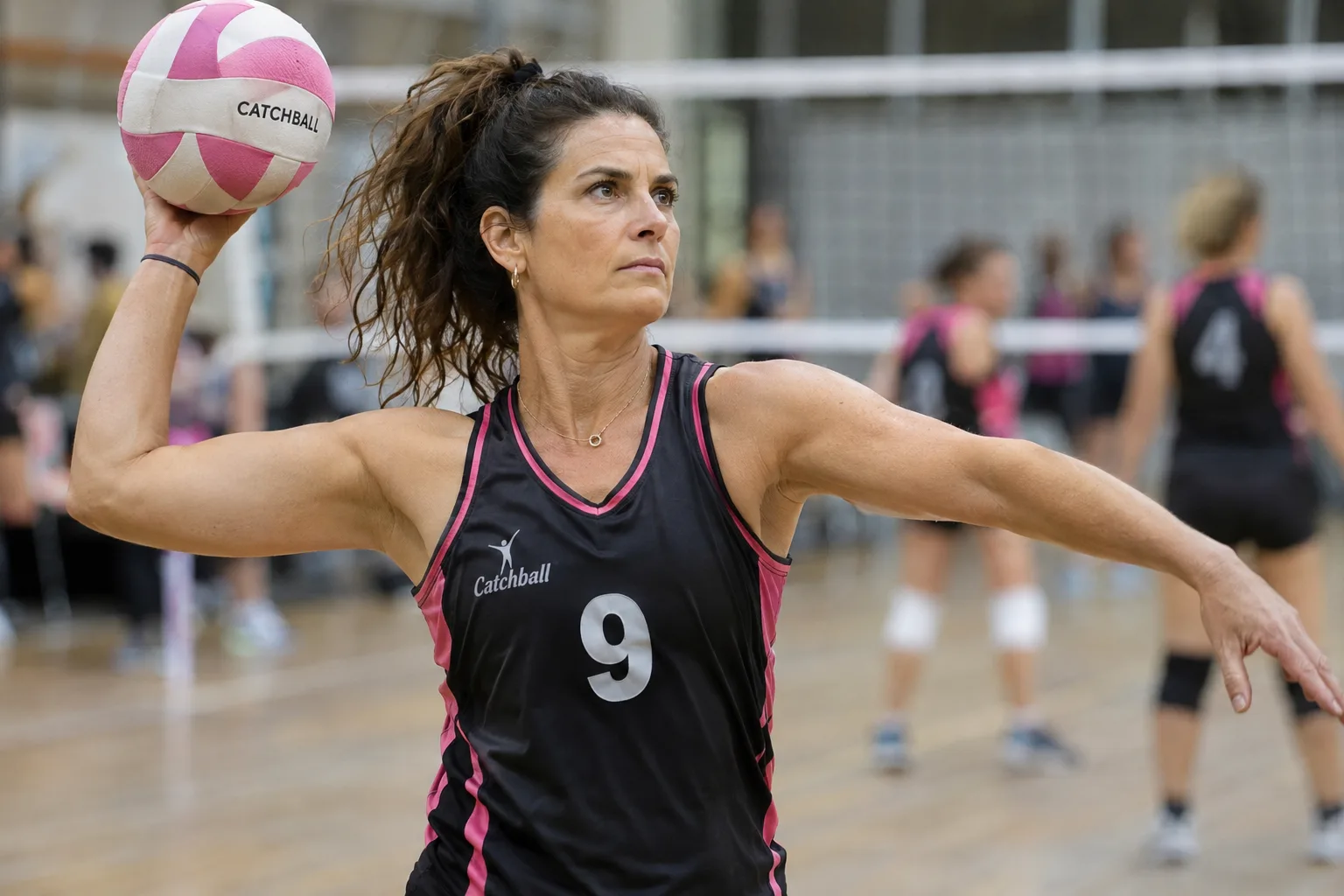
- The player in position 1 (right back) serves from the serving zone.
- The serve is a throw, within 5 seconds of the referee’s whistle (Mamanet allows 8 seconds).
- The server may not touch the court or the end line while serving.
- Faults: the ball touches a teammate, does not cross between the antennae, or teammates screen the server.
- Opponents may not block a serve.
Attack, block and the net
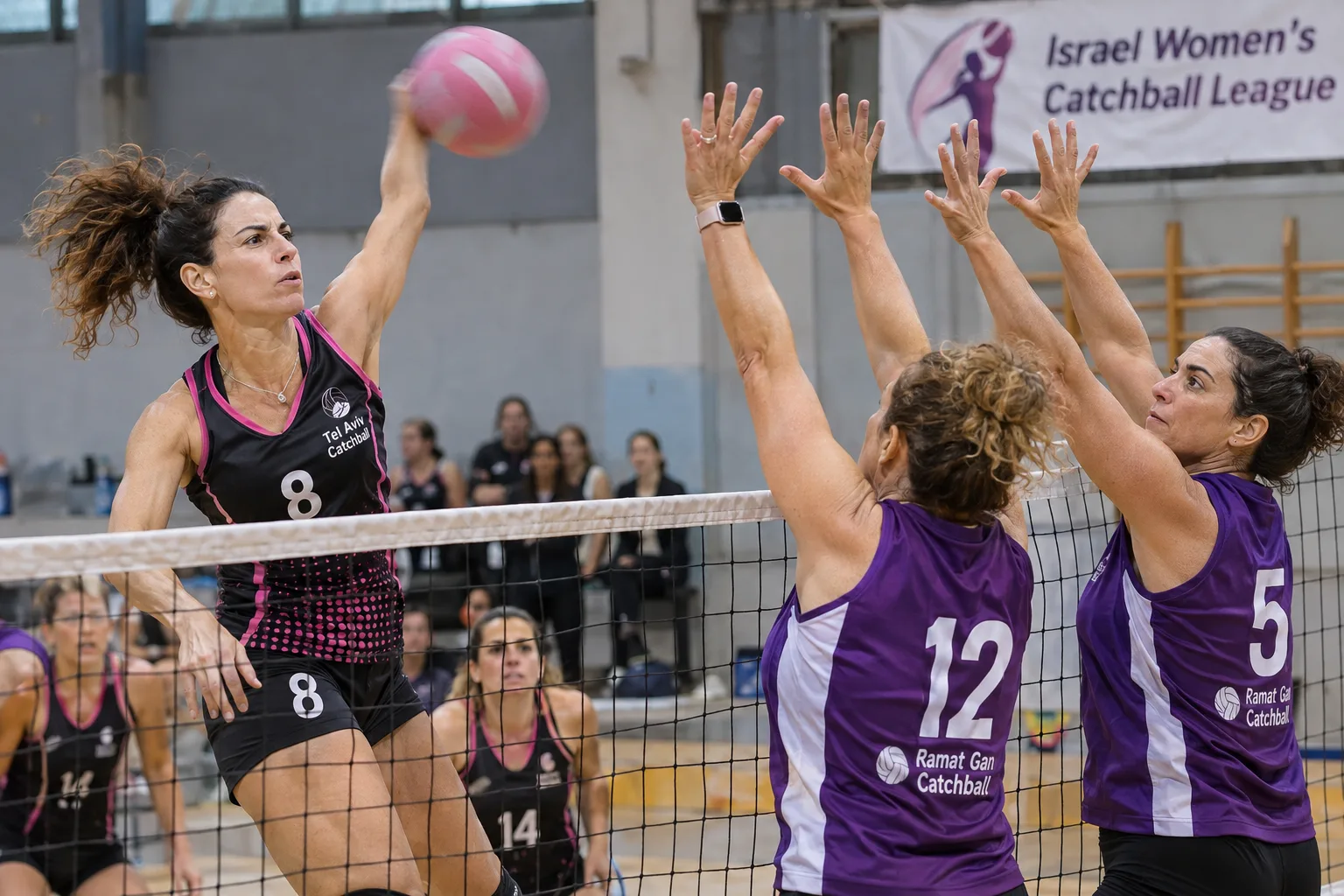
- Only front-row players may block, with hands above the top of the net. A block is not one of the 3 contacts.
- A back-row player may not complete a jump attack from the front zone when the ball is fully above the net.
- Touching the net between the antennae during play is a fault (unless unintentional and away from the ball).
- Crossing under the net is allowed only if it does not interfere with the opponents; touching the ball in their space before they play it is a fault.
Scoring, sets and in/out
Every rally gives a point to the team that wins it (rally-point scoring). A match is best of three sets: under ICF rules, sets 1 and 2 go to 25 and a deciding set to 15. Every set must be won by at least 2 points, and there are 3 minutes between sets.
The ball is out if it lands fully outside the lines, touches the antennae, posts, ceiling or a person outside play, crosses outside the crossing space or passes under the net.
Time-outs and substitutions
- 2 time-outs of 30 seconds per team per set, requested by the coach or captain between rallies.
- Up to 6 substitutions per team per set; several players may change at once.
- A starting player may leave and re-enter once per set, only to her original position.
- A substitute may enter once per set and can only be replaced by the player she replaced.
Referee signals
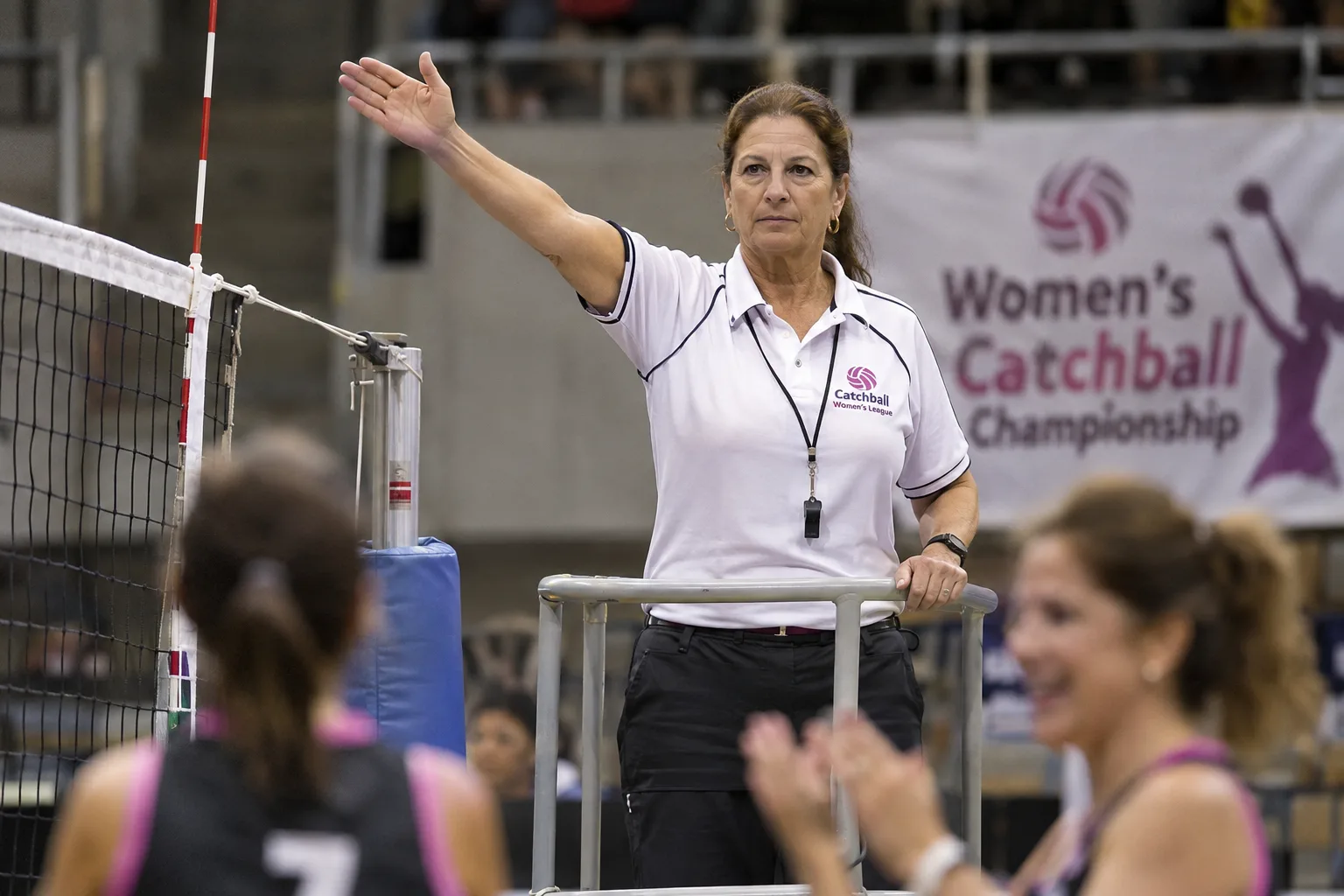
| Signal | Meaning |
|---|---|
| One finger raised | Ball held longer than 1 second |
| Forearms rotating around each other | Steps fault |
| Two fingers raised | Double contact |
| Four fingers raised | Four contacts |
| Eight fingers raised | Delay in serving |
| Arm and fingers pointing to the floor | Ball in |
| Forearms raised, palms facing the body | Ball out |
| Finger making a circle | Position or rotation fault |
| Hand on the side of the net | Net touch |
| Arm extended up, palm open | Ball hit or kicked |
| Both thumbs up | Double fault, replay |
| Hand over fingers in a T | Time-out |
| Yellow / red card | Warning / penalty (point to the opponents) |
Signals as described in the Mamanet official rules (2015 edition), which follow the volleyball signal system.
ICF vs Mamanet: what is different
Most leagues follow the same core rules. The main differences between the international federation (ICF) and the Mamanet league are in set length and serve time.
| ICF 2022 | Mamanet (2015 ed.) | |
|---|---|---|
| Sets 1–2 | 25 points | 21 points |
| Deciding set | 15 points | 15 points |
| Serve time | 5 seconds | 8 seconds |
| Holding | 1 second | 1 second |
| Steps to pass | 1 | 1 |
| Net height | 2.24 m | 2.24 m |
| Time-outs / subs | 2 / 6 per set | 2 / 6 per set |
Leagues may adapt rules for local play. Always check your league’s current regulations.
Frequently asked questions
How many players are on a catchball team?
Six from each team are on court at once. A team needs at least 6 eligible players to start, and leagues usually register up to 12.
How many steps can you take with the ball?
One step after catching if you pass or throw without jumping, and up to two approach steps before a jump throw. Release the ball before landing.
How long can you hold the ball?
One second at most, under both ICF and Mamanet rules. Holding longer is a fault, signaled with one raised finger.
How many points is a catchball set?
Under ICF rules sets 1 and 2 go to 25 and a deciding set to 15. Mamanet plays sets to 21 with a deciding set to 15. All sets are won by 2.
Can you hit the ball in catchball?
No. Intentionally hitting or kicking the ball is a fault. The ball must be caught and thrown.
How high is the catchball net?
2.24 m at the center, the same height as women’s volleyball.
Can you block a serve?
No. Blocking or attacking the serve is not allowed.