 AI illustration
A game inventedby a woman, for women,in 1895. Reinvented by women 130 years later.
Catchball has many names and one surprising origin. This is the story of a teacher in New Orleans, a game that almost disappeared, and the women on four continents who brought it back.
Begin the storyChapter 1 · New Orleans
The teacher who couldn’t wait
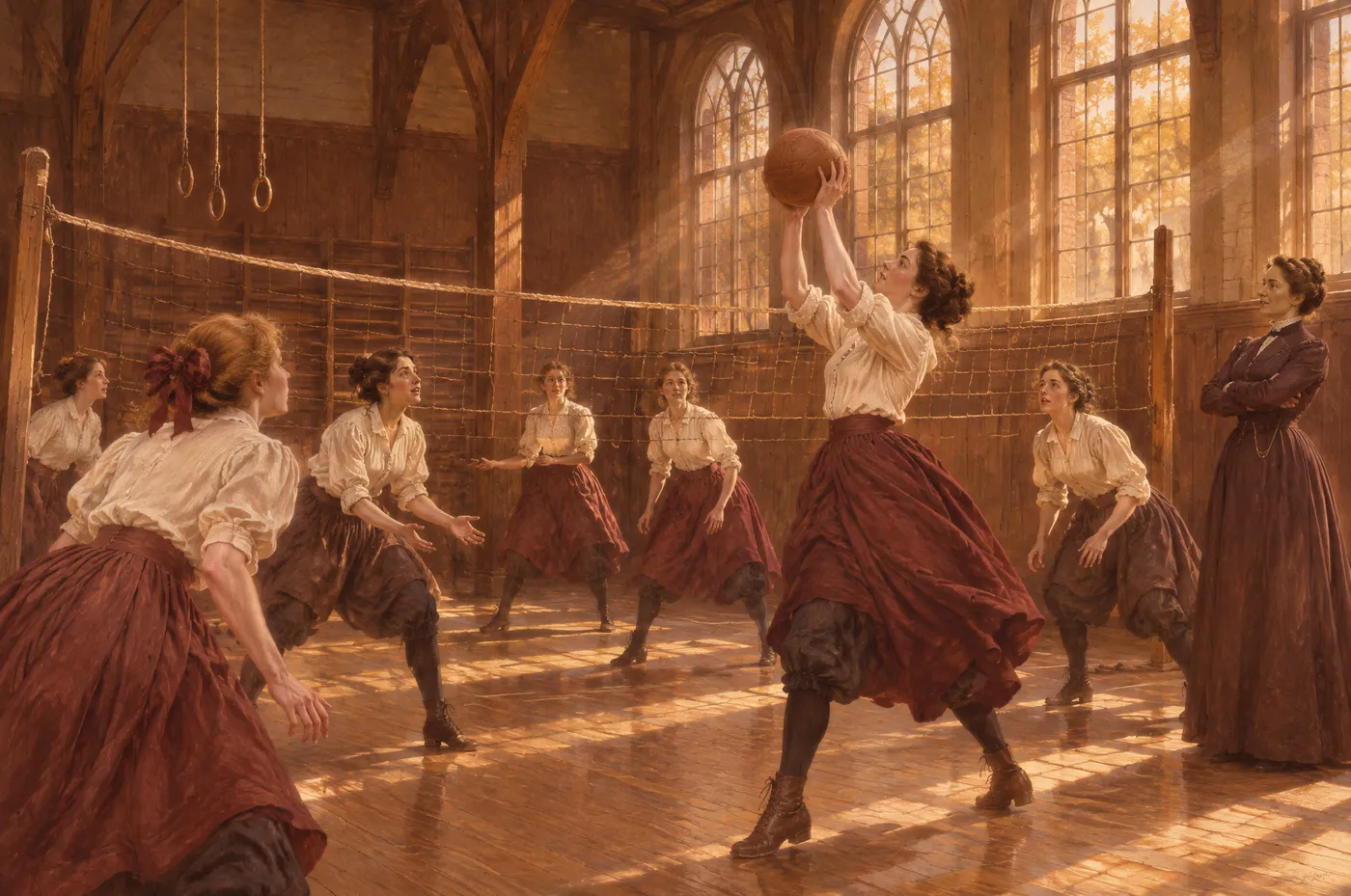
Clara Gregory Baer was born in 1863 in Algiers, Louisiana, and trained in physical education in Boston. Back in New Orleans she set out to give young women something they rarely had: a team sport of their own.
Who was Clara Gregory Baer?
A physical educator who studied at the Posse Normal School of Physical Education in Boston. In 1889 the all-male Southern Athletic Club in New Orleans opened its facilities to members’ female relatives for a few hours a week and hired Baer to teach them. In 1891 Sophie Newcomb College, the women’s college of Tulane University, hired her to build a physical education department.
How did the game begin?
In 1893 Baer brought basketball to Newcomb and to the American South, calling her version “basquette”. During the 1893–94 academic year she was waiting for the hoops she had ordered, so she invented a substitute: two teams, a rope across the room, and a ball thrown with enough force to hit the floor on the other side before anyone could catch it.
Why is it called Newcomb?
Her students loved the game so much that she kept it after the hoops arrived. Baer described it in a letter to the Posse Gymnasium Journal, published in January 1895, and named it after her college. Newcomb ball is one of the very few sports invented by a woman, and the second team sport played by women in the United States, after basketball.
What else did Baer change?
Her basquette rules played a role in the early development of netball. She created the first physical education teacher certification in the South in 1893 and the first four-year physical education degree in 1907, in a career that lasted 38 years.
Chapter 2 · The rise
A rival to volleyball

Newcomb ball and volleyball were born in the same year, 1895. For three decades it was not obvious which one would win.
How did the rules develop?
In 1910 Baer published an official rulebook with 22 rules and 16 fouls, built around scoring “touch-downs” by landing the ball on the opponents’ side. Around 1911 she formed a Newcomb advisory committee with educators from Boston, Detroit, Chicago and New Orleans. A revised rulebook in 1914 had 14 rules and 79 sections and allowed 6 to 12 players a side.
How popular was it?
Popular enough that Spalding sold a “Newcomb Outfit” of equipment. By the 1920s Newcomb ball rivaled volleyball in popularity and participation, and it was played in schools across the country.
Did Newcomb influence volleyball?
Possibly. William Morgan, a YMCA director in Massachusetts, created volleyball in 1895 as light exercise for businessmen. The historian Joan Paul, writing in the Journal of Sport History in 1996, noted that Baer’s game came about two years earlier, shared key features with volleyball, and was presented at a national convention that Morgan also attended. She argued it may have been a blueprint, while noting the similarities could be coincidental.
Chapter 3 · The quiet years
The game that went to camp
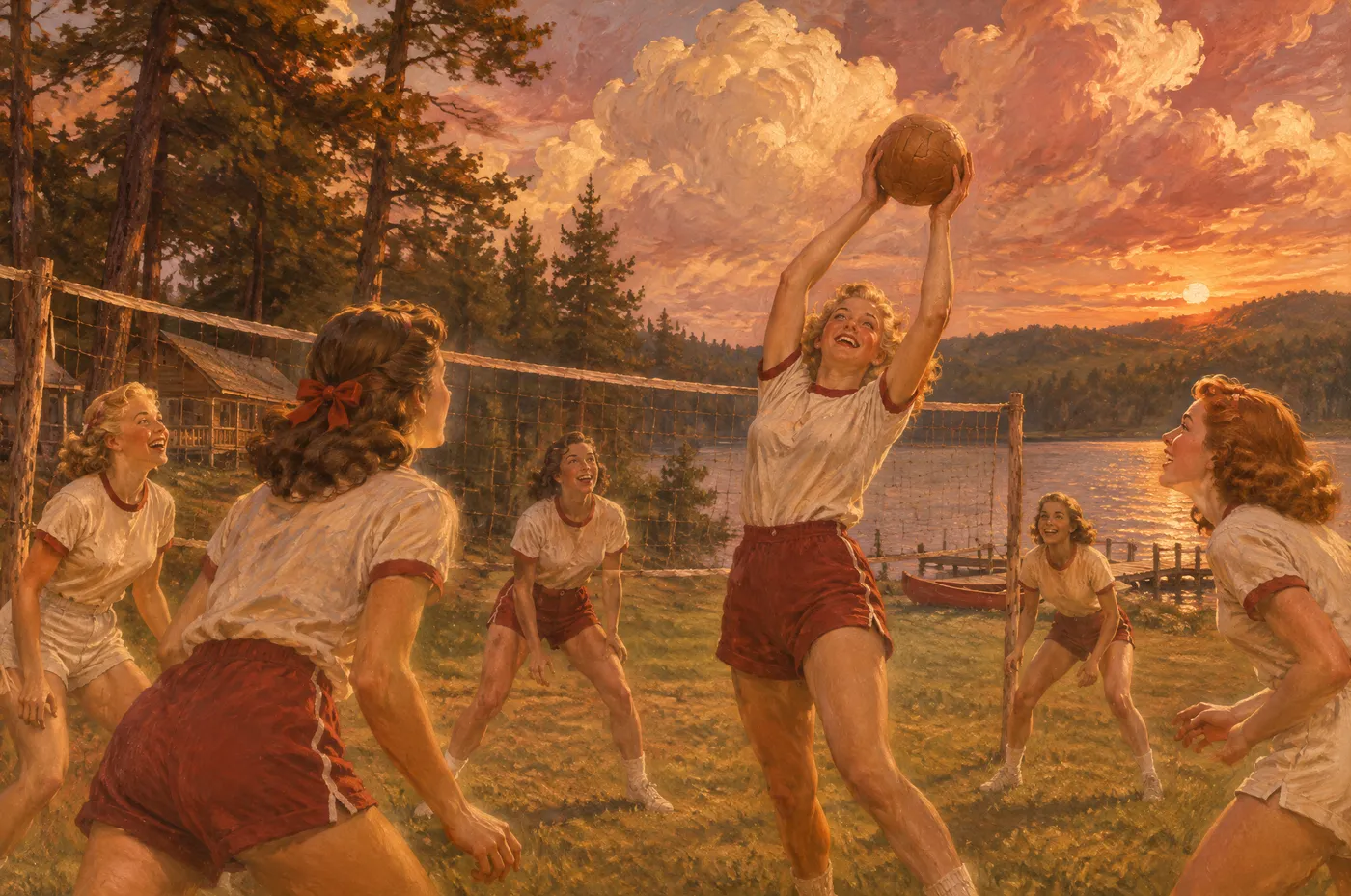
Volleyball became an international competitive sport. Newcomb ball did not. Baer herself added volleyball to her curriculum in 1923–24, and the game she invented slowly slipped out of the record books.
Why did Newcomb fade?
Joan Paul pointed to gender expectations, differences in difficulty between the two games, and the fact that a sport created by a woman and loved by women was stereotyped as “feminine”. The result, she wrote, was a lack of historical information about women’s contributions to sport.
Where did it survive?
In school gyms and summer camps. Newcomb remained a recreational game, a first step toward volleyball, and a game for people of every ability. It also lived on at summer camps, including camps in New England where it is still played.
Did it travel abroad?
Yes, quietly. There is evidence of the game in Canada, Mexico, China, Argentina, Australia and Israel. In Spanish-speaking countries it became cachibol, and India’s throwball is a close relative.

“A game that has no age.”
— A catchball player, to mako
Chapter 4 · Latin America
Cachibol and Newcom
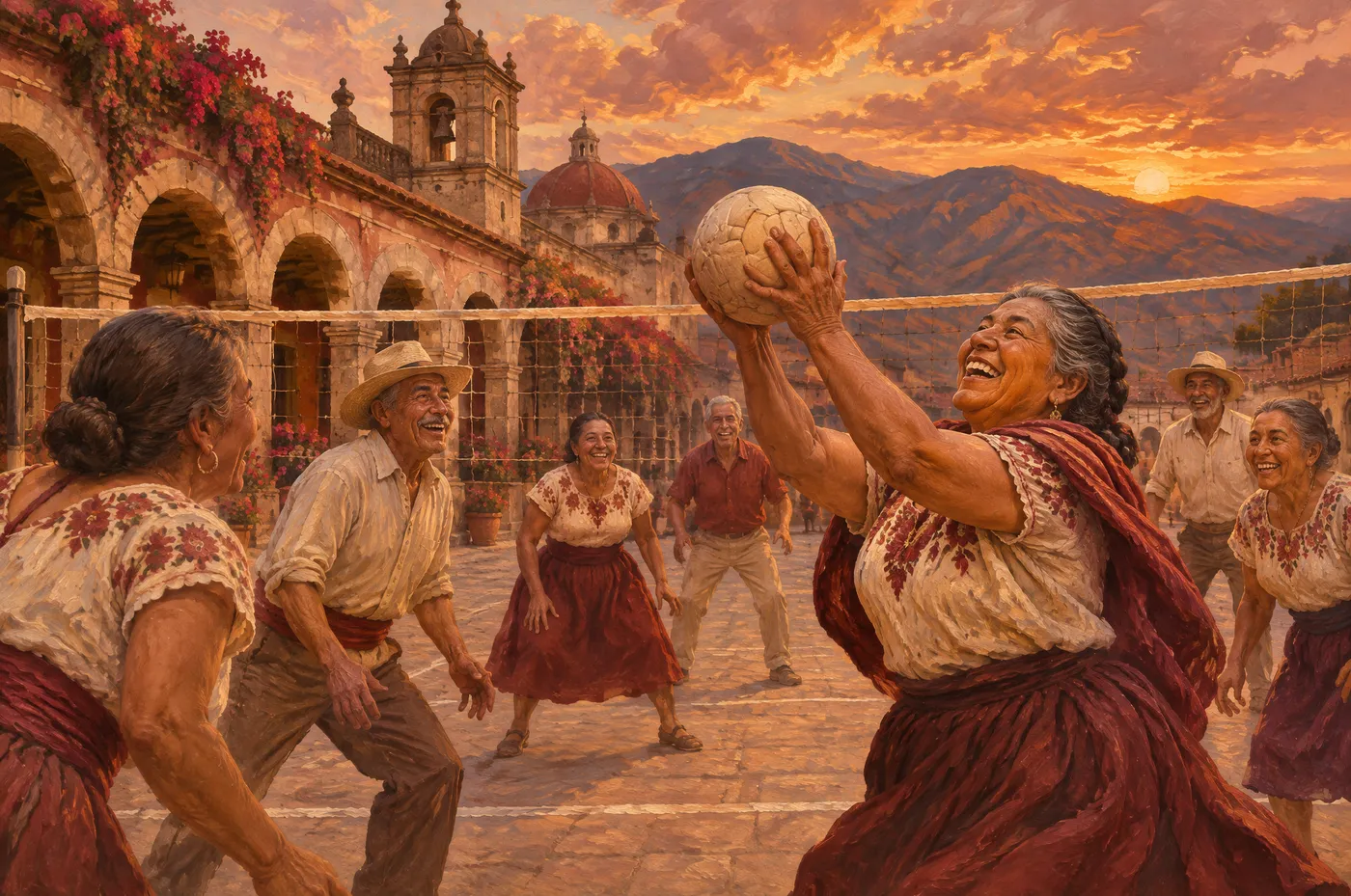
While Newcomb faded in the United States, it put down roots south of the border, often as a game for adults who wanted to keep playing long after their competitive years.
How big did it become in Mexico?
Mexico has the largest and longest-established catchball community outside Israel, with about 20,000 women players according to the International Catchball Federation. In La Laguna the game has been played since the early 1990s, and national championships have drawn hundreds of players.
And in Argentina?
Newcom reached Argentina in the late twentieth century and was added to the national Juegos Evita in 2008 to get older adults active. Today the national tournament draws more than 600 players in +40, +50 and +60 categories.
What is the link to Israel?
A direct one. The man who brought the game to Israel was a physical education teacher from Argentina, where it was commonly taught.
Chapter 5 · Israel
Every mother can

The modern game was built in Israel by teachers, mothers and volunteers who turned a forgotten pastime into the country’s most popular team sport for women.
Who brought it to Israel?
Haim Borovsky, a physical education teacher who emigrated from Argentina, introduced the game in 1986, starting with women in Nazareth Illit. When he moved to Kfar Saba in 1998 he taught it there too, and it began to spread.
How did Mamanet start?
In 2005 Ofra Abramovich, a mother in Kfar Saba, organized 50 women into teams by their children’s schools. Within three months more than 200 women were playing. Mamanet, from “Mama” and “net”, turned mothers into players and children into fans.
When did it become organized?
A national league was formed in 2006, and the Israel Catchball Association was founded in 2009 to expand and promote the sport and to run nationwide leagues.
Chapter 6 · Going global
From Eilat to the world

Once the game was strong at home, Israeli organizers began to export it, together with the idea behind it: sport as a place for women who had been told they were too old, too busy or not athletic enough.
What were the Catchball Games?
An annual international tournament organized by the Israel Catchball Association in Eilat. In 2016 more than 2,000 players took part, including a joint team of Israeli and Palestinian women.
When was the International Catchball Federation founded?
In 2016. It grew from an Israeli social start-up into a federation with member leagues on several continents, offering tournaments, workshops and coaching.
How big had it become in Israel?
Big enough that, according to Israel’s Culture and Sport Ministry, catchball leagues had more than 12,000 women members, twice as many adult women as basketball, soccer, volleyball and tennis leagues combined. In 2017 catchball appeared at the Maccabiah Games for the first time.
130 years after Newcomb, the women are still catching.
Chapter 7 · Today
One game, many names

In the 2020s catchball became a truly international sport, with continental cups in Africa, national tournaments in the Americas and Europe, and a world club championship.
What happened in Africa?
Kenya introduced the game in January 2020 and became Africa’s champion within five years, winning the 2025 Africa Catchball Cup in Soweto unbeaten. Uganda, South Africa, Ghana, Tanzania and South Sudan now compete too.
Is there a world championship?
Yes, for clubs. In 2025 Dora Kfar Saba won the Club World Cup in Amsterdam, beating a team from the United States in the semifinal and a team from Haifa in the final. Teams from Mexico, Greece, Romania and the Netherlands also took part.
Where is it played now?
In about 52 countries, according to the ICF. Israel has 16 leagues, about 1,200 teams and more than 12,000 Association players; the USA Catchball Association supports more than 50 teams in 14 states; and Maccabi communities from Kansas City to Germany started new teams in 2026.
Timeline
- 1863Clara Gregory Baer is born in Algiers, Louisiana
- 1891Baer starts physical education at Sophie Newcomb College, New Orleans
- 1893–94Waiting for basketball hoops, Baer invents a new net game
- 1895The game is published as “Newcomb”; volleyball is invented the same year
- 1910First official rulebook: 22 rules, 16 fouls
- 1914Revised rules; Spalding sells a “Newcomb Outfit”
- 1920sNewcomb rivals volleyball in popularity
- 1986Haim Borovsky brings the game from Argentina to Israel
- 2005Ofra Abramovich founds Mamanet in Kfar Saba
- 2008Newcom joins Argentina’s Juegos Evita
- 2009The Israel Catchball Association is founded
- 2016The International Catchball Federation is founded
- 2017Catchball appears at the Maccabiah for the first time
- 2020Kenya takes up catchball
- 2025Kenya wins the Africa Cup; Dora Kfar Saba wins the Club World Cup
- 2026About 52 countries; new teams on five continents
Write the next chapter
The game that Clara Baer invented for her students is waiting for you in a school gym near you. Learn the rules, find a team, or start one.
Questions & answers
Who invented catchball?
Catchball descends from Newcomb ball, invented by physical education teacher Clara Gregory Baer at Sophie Newcomb College in New Orleans and published in 1895.
When was catchball invented?
Baer created the game during the 1893–94 academic year and described it in print in January 1895, the same year volleyball was invented.
How did catchball come to Israel?
Haim Borovsky, a physical education teacher from Argentina, introduced it in 1986. Mamanet was founded in 2005 and the Israel Catchball Association in 2009.
Is catchball older than volleyball?
They were born the same year, 1895. Baer’s game was created about two years before its publication, and historian Joan Paul has suggested it may have influenced volleyball.
Sources
- mako – כדורשת: הספורט שכובש את נשות ישראל
- Wikipedia – Clara Gregory Baer
- Wikipedia – Newcomb ball
- Joan Paul – A Lost Sport: Clara Gregory Baer and Newcomb Ball, Journal of Sport History 23:2 (1996)
- Tulane University – Clara Gregory Baer
- The Tower – Israeli women, playing a game, conquering the world
- Jerusalem Post – Israelis, Palestinians catch up in Eilat at the International Catchball Games (2016)
- JTA – This women’s sport you’ve never heard of is taking Israel by storm
- Shalom Austin – Catch up with Texas’s first catchball team and champions (2021)
- Ynetnews – They won the catchball Club World Cup, but Israel’s champions still pay to play (2026)
- Maccabi World Union – Empowering communities through sport (Catchball initiative, March 2026)
- Sitio Andino – Malargüe se prepara para recibir el XII Torneo Nacional de Newcom (2025)
- The Standard – Kenya wins Africa Catchball Cup in South Africa
- Nation – Kenya readies for catchball games in Las Vegas
All images on this page are AI illustrations inspired by oil painting; they do not depict real people or events.