In this article
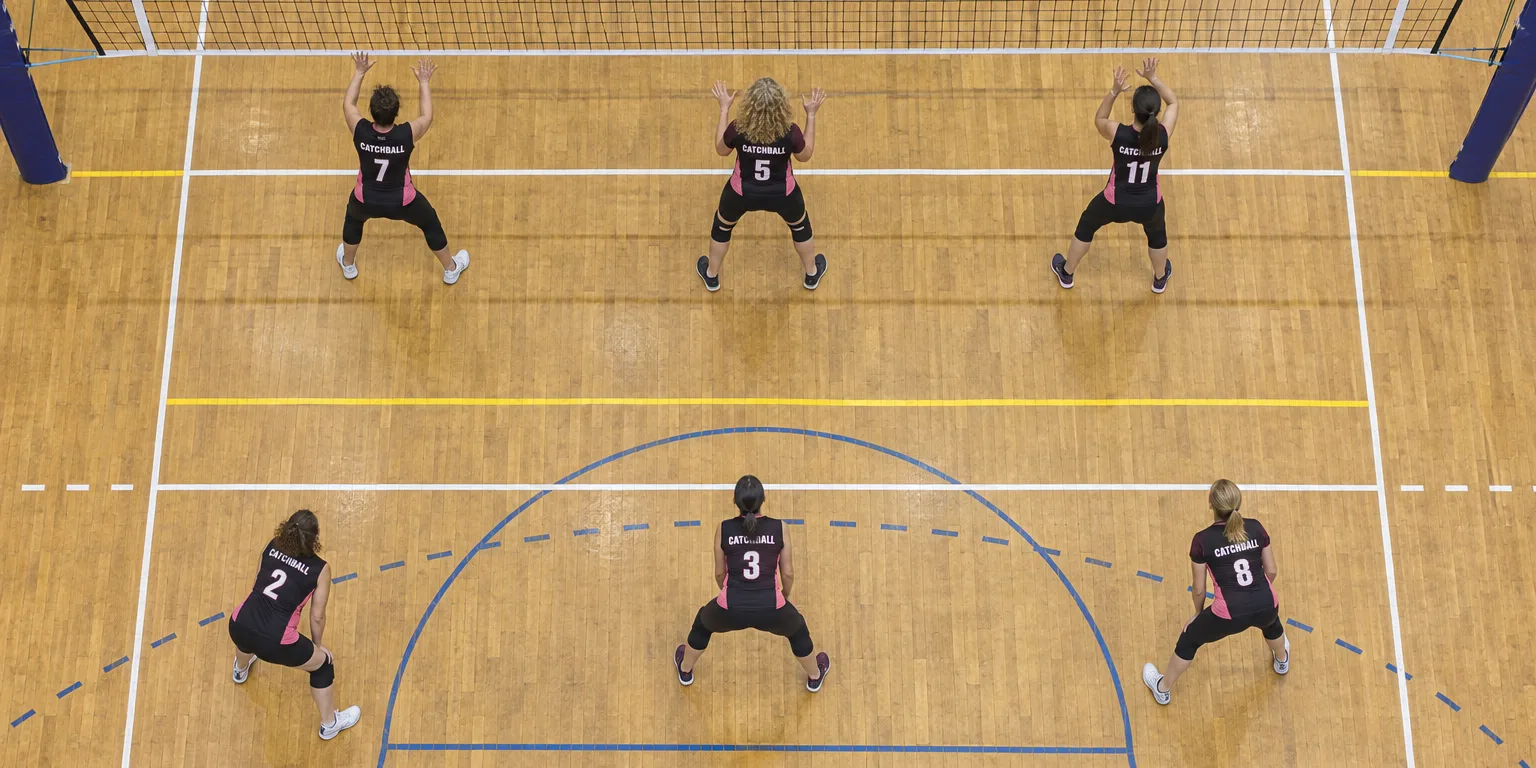
Each team has six players on court. The front row stands in positions 4, 3 and 2 (left to right, facing the net), and the back row in positions 5, 6 and 1. Position 1 is the right-back player, who serves.
| Row | Positions | Main job |
|---|---|---|
| Front | 4 · 3 · 2 | Attack throws over the net and block |
| Back | 5 · 6 · 1 | Receive serves, defend deep balls, serve (position 1) |
How rotation works
When the receiving team wins a rally, it wins the serve and every player moves one position clockwise. So over a set, everyone plays both front and back. Positions are checked at the moment the ball leaves the server’s hand; standing out of order gives the point and the serve to the opponents.
Who may do what
- Only front-row players may block, with hands above the top of the net.
- Back-row players may not finish a jump attack from the front zone when the ball is fully above the net.
- The Libero plays only in the back row and may not serve, block or attack from above the net.
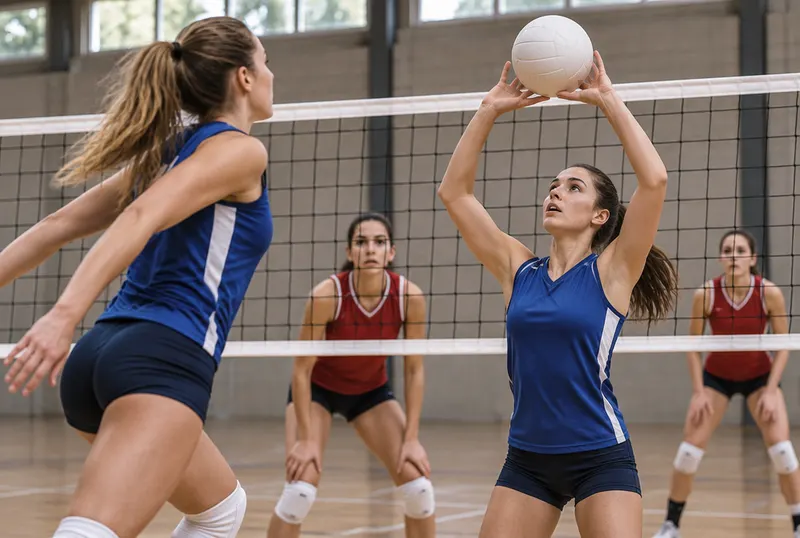 RelatedThe second pass: how to set up the perfect catchball attack
Rotation in practice: a short example
Your team receives serve and wins the rally. Before you serve, all six players move one position clockwise: the player in position 2 moves to 1 and becomes the server, 1 moves to 6, 6 to 5, 5 to 4, 4 to 3 and 3 to 2. If you keep winning rallies, the same server keeps serving and nobody rotates.
Overlap: where you must stand at the serve
At the moment of the serve each front-row player must be nearer the net than the back-row player behind her, and each player must be correctly placed relative to her neighbors on the left and right. After the serve everyone may move freely.
How the libero fits in
The libero wears a different color, plays only in the back row and replaces a back-row player without counting as a regular substitution. She may not serve, block or complete an attack above the net, which makes her a pure defensive and receiving specialist.
What each position does
| Position | Zone | Main job |
|---|---|---|
| 1 | Right back | Serves; defends the deep right corner |
| 2 | Right front | Blocks and attacks on the right; often the setter’s target zone |
| 3 | Middle front | Blocks in the middle; quick attacks |
| 4 | Left front | Main attacker; blocks the opponents’ right side |
| 5 | Left back | Defends deep left; strong receiver |
| 6 | Middle back | Covers the center and short balls behind the block |
Specialists: setter, attackers and libero
Most recreational teams rotate everyone through every role. As a team improves, coaches start to specialize: one or two reliable catchers become setters, the strongest throwers become attackers, and a quick, steady defender may play as libero. Specialists still rotate on paper, but after the serve they move to the position where they are most useful, as long as back-row players do not attack from the front zone.
Switching after the serve
Once the server releases the ball, players may move anywhere on their side. A common pattern is to bring the setter to the right front zone and the best attacker to the left front zone whenever both are in the front row. Practice the switch slowly: it only works if every player knows where to go without looking.
Common rotation faults
- The wrong player serves after a side-out.
- Two neighbors overlap at the moment of the serve.
- A back-row player jumps and throws from in front of the attack line.
- The libero tries to serve or block.
Drill: walk the rotation
Put six cones on the court numbered 1 to 6. The coach calls “side-out” and the team rotates; the coach calls a number and the player standing there must say her role in that rotation. Repeat until the team can complete six rotations without a mistake, then add a serve and a live rally.
Frequently asked questions
Which way do you rotate in catchball?
Clockwise, one position, each time your team wins back the right to serve.
Enjoyed it? Share it with your team